Lowrance Machine delivers focused, high-quality production and prototype work that holds tight tolerances and complex geometries. Visit our website at www.lowrancemachine.com to discover how our Industrial CNC Machining services serve aerospace, medical, and automotive applications.
Precision Manual Machining Services For Industrial Components
Our team operates advanced CNC machines and numerical control systems to keep efficiency and consistency steady across the manufacturing process. We work with a wide range of materials, from stainless steel to plastics, and apply precise cutting tools to produce high-quality parts with clean surface finishes.
Through integrated CAD software, we convert product designs into production-ready components. Whether you need a single prototype or larger production runs, our CNC machining process is refined for quality and repeatability. Clients receive clear communication, fast setup, and measured results for every part.
Trust Lowrance Machine for precision-focused solutions that match your design requirements and dimensional needs.
- Lowrance Machine supports expert Industrial CNC Machining services at www.lowrancemachine.com.
- Modern CNC equipment and numerical control support precise, fast production.
- Available material options include stainless steel and common plastics for diverse parts.
- Digital CAD tools and process controls support prototypes and larger runs.
- Focus on surface quality, tight tolerances, and reliable manufacturing results.
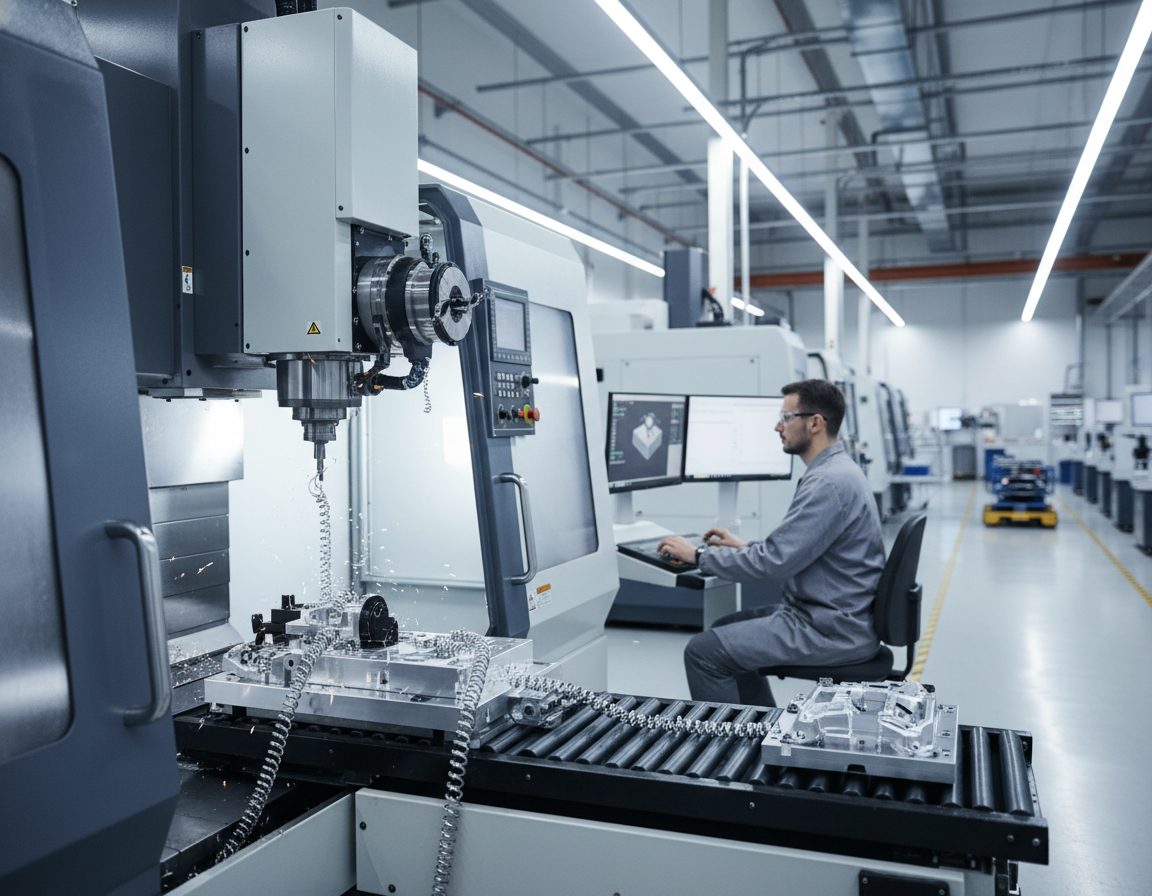
Industrial CNC Machining Explained
Subtractive methods shape parts by cutting away material from a solid block to achieve precise geometry.
Understanding Subtractive Manufacturing
Material-removal manufacturing removes material to produce consistent parts with predictable bulk properties. This process works well with metal and plastic and gives finished parts reliable physical properties.
The Digital Workflow From CAD To Part
Work starts with an engineer creating a CAD model. That CAD file is converted into G-code by CAM software. The G-code tells the machine exact tool paths and feed rates.
A Short History Of Automated Manufacturing
Automated manufacturing history stretches from a simple lathe-made bowl in 700 B.C. to today’s computer-guided centers.
In the 18th century, steam power enabled the first mechanical machines that sped up the manufacturing process. These machines set the stage for mass production and repeatable parts.
At MIT in the late 1940s, engineers built the first programmable machine using punched cards. That development led to early numerical control and helped create program-driven work.
During the 1950s and 1960s added digital computers and created the modern CNC era. The Milwaukee-Matic-II later brought in an automatic tool changer, cutting setup time and improving throughput.
Over centuries, the machining process advanced to handle many materials. Today’s machines use software, hardware, and controls to run efficient CNC machining processes for diverse projects.
- Ancient era, 700 B.C.: lathe-crafted bowl — early turning concept
- Industrial-era automation: steam-driven automation
- Programmable manufacturing era: punched cards to computers and tool changers
Common CNC Machine Categories
Core machine types split into milling centers and turning lathes, which together support most part needs.
Milling systems remove material with rotating cutters to create complex pockets and faces. Lathe systems shape round profiles by holding stock and cutting with tools on a rotating axis.
Beyond milling and turning, the range includes laser and plasma cutters for thin materials and EDM units for hard alloys or delicate features. Each machine supports specific applications and meets certain material limits.
- Milling Operations — best for contours, slots, and multi-axis details.
- Turning Operations — ideal for shafts, threads, and cylindrical parts.
- Laser, Plasma, And EDM — chosen when cutting type or material rules out standard cutting tools.
When selecting, a CNC machine, engineers weigh the manufacturing process, material properties, and required precision. Choosing the right type reduces cycle time and improves final part quality under numerical control.
Three Axis Milling Systems Explained
Across many component projects, three-axis mills deliver an balanced combination of cost and capability.
Three-axis systems allow the cutting tool move left-right, back-forth, and up-down to shape parts. That basic movement pattern handles pockets, faces, slots, and basic contours with high repeatability.
Managing Tool Access Restrictions
Machining access is a frequent design constraint on three-axis equipment. Some features remain in cavities or behind ledges that a straight tool path cannot reach.
Designers and machinists reduce access issues by resetting the part, adding fixtures, or breaking the job into setups. Careful planning of the machining process cuts rotations and saves time.
- Three-axis equipment works for many applications and keep cost per part low.
- Well-planned fixtures minimizes extra setups and reduces production cost.
- High-speed cutting tools remove material quickly while holding tight tolerances.
As a reliable process within modern manufacturing, three-axis milling supports reliable production of well-defined parts across multiple industries.
The Efficiency Of CNC Turning
Lathe systems spin workpieces while a fixed tool trims and shapes steady, round geometry. A rotating spindle holds the workpiece at high speed so the tool can cut precise cylindrical features with repeatable accuracy.
CNC turning excels for parts with rotational symmetry, like shafts, screws, and washers. That makes it a practical method when you need many identical components for production runs.
Since the workpiece spins while the tool stays fixed, machines achieve tight tolerances on outer and inner diameters. Optimizing speed and feed rates lowers cycle time and lowers the cost per part without losing quality.
- High-speed, reliable approach for round parts and features.
- Lower production cost for high-volume production.
- Strong accuracy on cylindrical components due to fixed-tool geometry.
- Straightforward stock handling and rapid setup for short lead times.
Applied together with other CNC machining methods, turning helps manufacturers meet demanding schedules and produce durable, well-finished parts for diverse applications.
Advanced Five Axis Machining Capabilities
If a design needs multiple approach angles, five-axis systems deliver that flexibility in one setup. These centers reduce handling, speed up production, and improve precision on complex components.
Indexed Five Axis Milling Systems
Indexed milling systems lock two rotary axes between cutting passes. This lets a mill reach angled faces without constant re-fixturing.
That produces better accuracy for features that need exact orientation. Indexed setups are practical when tool access must change but full simultaneous motion is unnecessary.
Continuous Multi-Axis Milling
Simultaneous five-axis milling moves all five axes at once. That capability produces smooth, organic surfaces on high-performance parts.
The process also cuts cycle time for complex geometry and reduces secondary finishing. Use continuous motion when surface quality and tight tolerances matter most.
CNC Mill-Turning Centers
Hybrid mill-turn machines combine lathe productivity with milling flexibility. Stock can be turned and then machined with multiple tools in one machine.
This dual-capability setup lowers setups for round parts with added features. It offers a cost-effective route to produce accurate components from metal and other materials.
- Key capabilities: multi-angle access, fewer setups, and higher repeatability.
- Fits advanced manufacturing for aerospace and medical applications that require complex parts and tight precision.
Main Benefits Of Modern CNC Processes
CAD/CAM integration and high-speed movement let manufacturers produce parts within tight tolerances. This capability reduces scrap and speeds delivery for both prototypes and short runs.
Tolerance management is commonly tight: standard accuracy often sits near ±0.125 mm, with skilled setups reaching ±0.025 mm. That level of precision supports aerospace, medical, and automotive needs.
Modern CAM tools and control software shorten the path from design to finished parts. Automation keeps quality consistent, so every piece follows the drawing with repeatable results.
- Quicker prototypes and reduced lead times — many orders ship in about five days.
- Finished parts keep the bulk material properties needed for high-performance use.
- Complex geometries are now cost-effective compared with old formative methods.
| Advantage | Common Result | Delivery Impact |
|---|---|---|
| Precision | Tight ±0.025–0.125 mm control | Fewer reworks |
| Software-driven CAM | Refined tool paths | Reduced production timing |
| CNC automation | Steady production quality | Reliable batches |
Design Constraints And Common Limitations
Reliable reach for the cutting cutting tool is as important as the part geometry itself. Many features cannot be made if a tool cannot reach the surface without colliding or bending.
Managing Workholding And Stiffness
Poor fixturing or low workpiece stiffness causes vibration. That chatter lowers dimensional accuracy and weakens surface finish.
Project teams should check clamping points and part rigidity during early review. Small changes to the design can often reduce the need for complex fixes later.
- One major constraint is the need for a cutting tool to have a clear path to every required surface.
- Workholding problems arise when a part lacks stiffness, leading to vibrations and reduced final accuracy.
- Design decisions should consider secure clamping and tool access early to avoid rework.
- Advanced geometries can require custom fixtures or staged setups, raising cost and lead time.
- Understanding these limits helps optimize parts for efficient, high-quality CNC machining.
Selecting The Right Materials For Your Project
Start the process by matching the material to the part’s intended function and environment. Choosing early reduces cost and prevents rework.
Material choices often include metals such as aluminum, brass, copper, and various steel alloys. For high-strength parts, stainless steel and other steel grades deliver durability and wear resistance.
Common plastics including ABS, Delrin, and PEEK provide electrical insulation and low weight. Use engineering-grade plastic when heat dissipation or chemical resistance matters.
- Material selection affects performance, cost, and finish quality.
- Metal materials support strength and thermal demands; steel is common where toughness is needed.
- Engineered plastics fit electrical insulation, lighter weight, or tight budgets for small runs.
- Different materials have unique machining characteristics that influence surface finish and tolerance.
- Reviewing options with Lowrance Machine helps align materials to function, lead time, and budget.
CNC Applications Across Diverse Industries
High-precision manufacturing powers key sectors, from flight hardware to custom automotive parts.
Across aerospace applications, manufacturers use CNC machines to make lightweight, high-tolerance parts such as turbine blades and structural brackets. These products must meet strict certification and safety rules.
The vehicle industry uses the same accuracy for performance components. Some firms, like PAL-V, use precise production for parts that enable vehicles to operate on road and in the air.
Electronics manufacturers require custom enclosures and PCB fixtures. These parts help with heat dissipation and electrical isolation for sensitive devices.
- Uses cover aerospace, automotive, electronics, defense, and more.
- Lowrance Machine offers a wide range of manufacturing solutions for diverse industries.
- Consistent machining transforms designs into durable, ready-to-use products.
| Sector | Common Parts | Key Requirement | Material Choice |
|---|---|---|---|
| Aviation | Flight brackets and blade components | Strict tolerance plus certification | Specialty metal alloys |
| Transportation | Performance fittings and drivetrain parts | Reliable durability | Steel and aluminum |
| Electronic Manufacturing | PCB fixtures and enclosures | Insulation and thermal control | High-performance polymers |
Precision Requirements In The Aerospace Industry
Aircraft components demand exact tolerances and complex geometry that few sectors require. Parts must survive extreme loads, temperature swings, and fatigue over long service lives.
Production specialists handle advanced metal alloys and composite materials that are hard to shape. These materials need specialized equipment and careful process planning to yield each part to spec.
The shift toward lighter structures is clear: Boeing’s 787 uses about 50% composite materials, while the Airbus A350XWB approaches 53%. That trend raises the bar for precision and material handling.
Each component receives strict quality control, from dimensional inspection to material certification. Meeting these requirements ensures safety and long-term performance for the aircraft.
| Production Requirement | Expected Target | Impact on Production |
|---|---|---|
| Tolerance | Tolerances around ±0.025–0.125 mm | More setups, tighter control |
| Materials | High-strength metal alloys & composites | Specialized tooling and feed rates |
| Inspection Quality | Full traceability & inspection | Added validation time |
Lowrance Machine supports these requirements and supports aerospace programs with the expertise to deliver precise components and consistent part quality.
Manufacturing Standards For Medical And Electronics
Medical and electronics manufacturers depend on swift, exact production for critical housings and instruments.
How Medical Precision Is Met
Healthcare device parts must meet exact dimensions and strict traceability. Implants, surgical tools, and robotic arms all require consistent inspection and documentation.
A California start-up such as Galen Robotics uses precision work to make parts that steady a surgeon’s hands during delicate ENT procedures. These parts protect patients and reduce infection risk.
Fast production and consistent quality shorten time to market for custom implants and single-use instruments. Process control and material traceability are essential in this field.
Custom Electronic Enclosures
Electronics products depend on rigid, thermally stable housings. The MacBook’s single-piece aluminum casing is a well-known example of a metal part milled for stiffness and finish.
Manufacturers produce sensor mounts, heat sinks, and complex housings to tight tolerances so components fit and function reliably.
- Efficient accuracy cuts rework and help meet certification timelines.
- Surface finish, material choice, and inspection affect long-term performance.
- Traceable processes help ensure every component matches required specs.
| Industry Sector | Primary Requirement | Material Choice |
|---|---|---|
| Medical Devices | Micron-level tolerance and traceability | Biocompatible titanium and alloys |
| Electronic Components | Heat management and stiffness | Coated metals and aluminum |
| Medical And Electronics | Fast delivery supported by quality records | Engineering plastics and metals |
Lowrance Machine works toward delivering precision machining services that meet these standards. We combine speed with control to produce parts and components that pass rigorous inspection and perform in the field.
How To Reduce Production Costs
Small changes early often yield the biggest savings. Ordering multiple units spreads setup and tooling over many pieces and can cut unit price as much as 70% when you move from a one-off to a run of ten identical parts.
Reduce design complexity to avoid complex geometry that forces extra setups or special tools. That lowers cycle time and reduces manual finishing.
- Use scale efficiencies by batching orders to reduce per-unit production cost.
- Choose materials early so you avoid rework and wasted stock.
- Standardize tolerances and remove unnecessary features to save machining and inspection time.
- Collaborate with Lowrance Machine during review to optimize parts for lower cost without losing quality.
| Strategy | Why it Saves | Expected Saving |
|---|---|---|
| Batch ordering | Distributes setup and tooling over more parts | Potentially up to 70% per part |
| Simplified design | Removes unnecessary machining steps | 15–40% |
| Early material choice | Reduces rework and scrap | 10–25% |
| Tolerance standardization | Fewer custom operations and less inspection | Often 5–15% |
Quality Control And Surface Finishing Options
End-stage checks and finishing are the last steps that protect fit, function, and finish.
Quality assurance guides our process. Every part goes through dimension checks and visual inspection to confirm tolerance and surface quality. We document results so you get traceable, reliable parts.
Finishing options enhance both looks and performance. Light bead blasting, anodizing, chromate conversion, and powder coating are available. These treatments support corrosion resistance and give consistent surfaces.
Machining tools typically produce a radius on sharp inside corners. Designers should account for that radius when specifying tight inside features to avoid fit issues later.
- Strict inspection: dimensional checks, surface reviews, and reporting.
- Available finishing methods: bead blast, anodize, chromate, powder coat.
- Design note: inside corner radii result from tool geometry and must be planned.
| Quality Process | Main Benefit | Common Use |
|---|---|---|
| Dimension checks | Verifies accuracy | Important mating components |
| Bead blasting | Even low-gloss finish | Cosmetic surfaces |
| Anodizing / coatings | Improved environmental resistance | Harsh-environment metal parts |
Partner With Lowrance Machine For Precision Results
Choose Lowrance Machine to turn detailed design intent into reliable, production-ready components. Our approach pairs engineering review with disciplined shop practice so parts meet print and perform in service.
Our team runs a wide range of machines and maintain strict numerical control to keep every job on tolerance. Whether you send a single prototype or a larger run, our team focuses on quality, traceability, and predictable lead times.
- Get support from expert CNC machining services to handle complex project needs.
- Advanced machines and numerical control ensure components are built to spec.
- Lowrance Machine helps improve your design for better performance and lower cost during the machining process.
- Consistent production for single prototypes through high-volume orders.
- Review LowranceMachine.com to review capabilities and request a quote.
| Service Benefit | Reason It Matters | How to Start |
|---|---|---|
| Engineering design review | Cuts rework and lowers cost | Send project files via www.lowrancemachine.com |
| Precision-calibrated machines | Reliable accuracy | Discuss tolerances with our engineers |
| Process expertise | Faster time to production | Submit a quote request or call our team |
Final Thoughts
Reliable part manufacturing shortens time to market and cuts waste. It also supports reliable performance across aerospace, medical, and automotive projects.
Understanding machine types and process benefits helps teams choose the right approach and avoid costly redesigns. Our machining capabilities focus on tight tolerances, material choice, and efficient setups.
Lowrance Machine brings together engineering review with hands-on shop expertise to reduce cost and improve quality. We emphasize inspection, finishing, and material traceability so every part meets expectations.
Review LowranceMachine.com to learn how our machining services can support your next design and speed production.